

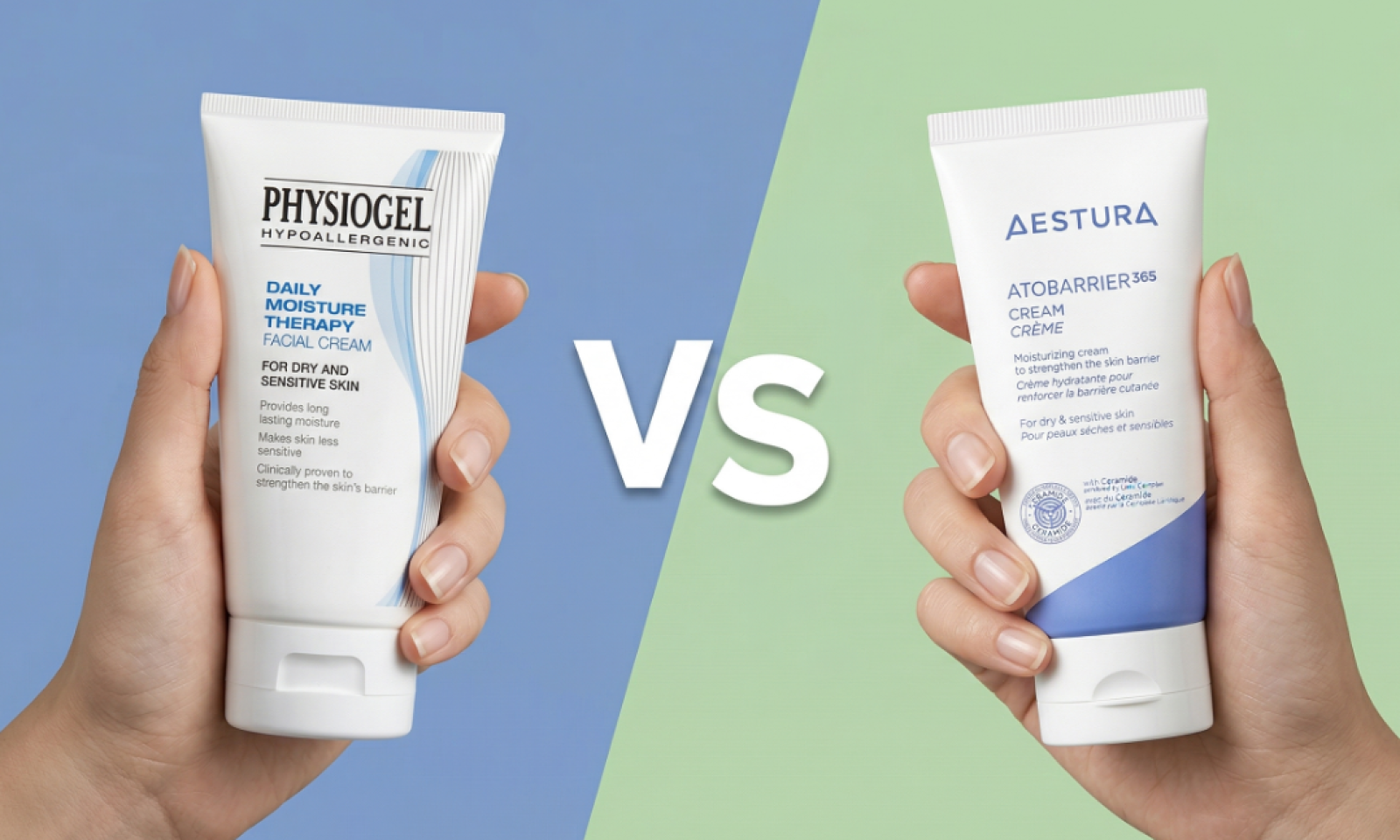
Two products, same category, similar price point — but very different formulas and real-world results.
In this guide, we break down [PHYSIOGEL] Daily Moisture Therapy Facial Cream and [AESTURA] ATOBARRIER 365 Cream side by side using ingredient data, safety ratings, and AI analysis of thousands of verified user reviews.
*This comparison was generated using AI analysis of 41,288 verified user reviews and full ingredient data from Hwahae.
Last updated: 2026-03-25


| [PHYSIOGEL] DAILY MOISTURE THERAPY FACIAL CREAM | [AESTURA] ATOBARRIER 365 CREAM | |
|---|---|---|
| Category | Face Moisturizers | Face Moisturizers |
| Price($) | $31.73 | $22.04 |
| Avg. Rating | 4.21★ | 4.68★ |
| Total Reviews | 25,884 | 15,404 |
| Category ranking | #24 | #1 |
Ingredient Breakdown — “What’s Actually Inside”
Ingredient Safety Comparison
| [PHYSIOGEL] DAILY MOISTURE THERAPY FACIAL CREAM | [AESTURA] ATOBARRIER 365 CREAM | |
|---|---|---|
| Total Ingredients | 42 | 42 |
| EWG 20 Ingredients to Avoid | 0 | 0 |
| EWG Potential Allergen Ingredients | 0 | 0 |
Best Ingredients by Skin Concern
| Best for | [PHYSIOGEL] – Key Ingredient | [AESTURA] – Key Ingredient |
|---|---|---|
| Severe dryness & tightness relief | Shea Butter (EWG 1) | Squalane (EWG 1) |
| Barrier strengthening & moisture lock-in | Ceramide NP (EWG 1) | Ceramide NP (EWG 1) |
| Sensitive-skin barrier soothing | Hydrogenated Lecithin (EWG 1–2) | Allantoin (EWG 1) |
| Overall hydration support | Glycerin (EWG 1–2) | Glycerin (EWG 1–2) |
🧑🔬 Ingredient & Safety Analysis
[PHYSIOGEL] Daily Moisture Therapy Facial Cream has 42 ingredients in total, 0 of which are flagged by EWG for potential allergy concerns.
[AESTURA] ATOBARRIER 365 Cream’s formula is more streamlined at 42 ingredients, with 0 allergy-watch flags.
When it comes to EWG’s 20 concern list, PHYSIOGEL contains 0 while Brand B has 0 – With both formulas showing zero EWG “20 concern” ingredients and zero potential allergens flagged, the key decision factor is less about red-flag safety counts and more about whether the richer, more occlusive oils feel too heavy or clog-prone for your skin type.
Where the two formulas really diverge is in their approach to specific skin concerns.
For acne-prone skin, PHYSIOGEL relies on Cocos Nucifera (Coconut) Oil to provide occlusive moisture-locking by reducing transepidermal water loss, while AESTURA opts for Dimethicone, which forms a breathable protective film that helps reduce moisture loss while smoothing the skin surface.
If anti-aging is your priority, both include retinol as the hero active, but PHYSIOGEL pairs it with Ceramide NP for barrier support, whereas AESTURA leans on Cholesterol to reinforce the skin’s lipid balance and improve moisture retention.
What Real Users Are Saying — AI Review Analysis
| [PHYSIOGEL] DAILY MOISTURE THERAPY FACIAL CREAM | [AESTURA] ATOBARRIER 365 CREAM | |
|---|---|---|
| Total Reviews | 25,884 | 15,404 |
| Avg. Rating | 4.21★ / 5.0 | 4.68★ / 5.0 |
What Reviewers Are Saying
[PHYSIOGEL] DAILY MOISTURE THERAPY FACIAL CREAM
* Based on 25,884 reviews analyzed by Hwahae AI, the following keywords summarize real user feedback at a glance.
😊 Pros
- Not Irritating
- Effective for Inner Dryness
- Doesn’t Flip
🙁 Cons
- Oily
- Causes Breakouts
- Causes Allergic Reactions
[AESTURA] ATOBARRIER 365 Cream
* Based on 15,404 reviews analyzed by Hwahae AI, the following keywords summarize real user feedback at a glance.
😊 Pros
- Not Irritating
- Effective for Inner Dryness
- Strengthens Skin
🙁 Cons
- Oily
- Causes Allergic Reactions
- Heavy
User Ratings by Skin Type
| Skin Type | Rating | [PHYSIOGEL] DAILY MOISTURE THERAPY FACIAL CREAM | [AESTURA] ATOBARRIER 365 CREAM |
|---|---|---|---|
| Oily | 👍 Good | 0 | 1 |
| Oily | 👎 Bad | 6 | 2 |
| Dry | 👍 Good | 6 | 3 |
| Dry | 👎 Bad | 0 | 0 |
| Sensitive | 👍 Good | 0 | 1 |
| Sensitive | 👎 Bad | 0 | 0 |
👍 Skin Type Recommendations
For Oily skin, [AESTURA] ATOBARRIER 365 CREAM has more positive feedback (1 good vs 0) and fewer negative mentions (2 bad vs 6), while [PHYSIOGEL] DAILY MOISTURE THERAPY FACIAL CREAM is more often criticized as oily and for causing breakouts.
For Dry skin, both products are well-liked with no negative feedback, but [PHYSIOGEL] shows stronger satisfaction (6 good vs 3) and is frequently praised for being effective for inner dryness.
For Sensitive skin, only [AESTURA] has positive feedback (1 good vs 0) with no negatives recorded, aligning with its “Not Irritating” praise and fewer complaints overall in this skin type.
⚡️🥊 Head-to-Head Comparison
We’ve analyzed both products based on Hwahae user reviews, ingredients, and ratings.
Here’s the final verdict — a side-by-side look at which product comes out on top in each category.
| Category | Winner | Why |
|---|---|---|
| Anti-aging potency | AESTURA | It is more favorable for barrier-focused conditioning with a ceramide complex, supporting healthier-looking skin over time. |
| Gentle / soothing | AESTURA | It is positioned as a more universally comfortable option across oily, combination, and sensitive skin types. |
| Value for money | AESTURA | It delivers a higher rating (4.68★ vs 4.21★) at a lower price point ($22.04 vs $31.73). |
| User satisfaction | AESTURA | It has a higher overall rating (4.68★ vs 4.21★) with strong ‘Not Irritating’ and ‘Effective for Inner Dryness’ praise. |
| Ingredient safety | AESTURA | Both lean low-EWG, but it is considered less potentially pore-burdening due to less emphasis on coconut oil. |
FAQ — All About Ceramide NP
Q1. What role does Ceramide NP play in the skin?
A. Ceramide NP is a lipid component that makes up the skin barrier, acting like a “cement” that fills the gaps between skin cells. By reinforcing the barrier, it helps prevent moisture loss and protects skin from external irritation, which can support reduced dryness, tightness, and frequent redness.
Q2. How should I layer a ceramide cream with other serums or toners?
A. Ceramide products generally work well as a final-step moisturizer. Use in this order: cleanse → toner → hydrating/soothing serum (e.g., hyaluronic acid, centella) → optional functional serum (brightening, anti-wrinkle) → ceramide cream. On days you use potentially irritating actives like retinol or acids (AHA/BHA/PHA), applying a generous layer of ceramide cream at the end can help support the barrier.
Q3. How often should I use a Ceramide NP product?
A. Ceramides are usually low-irritation, so it is generally fine to use them daily, morning and night. If you are new to it, start with a small amount once or twice per day, preferably at night, and increase as needed. In drier seasons, you can also layer a bit more. If your skin is already oily, apply a thinner layer on the T-zone and focus more on drier areas to keep balance.
Q4. Is Ceramide NP safe for sensitive or acne-prone skin?
A. Ceramide NP is naturally present in the skin, so most sensitive skin types tolerate it well. However, depending on the formula, you may still react to accompanying ingredients like oils, silicones, or fragrance, so patch-test a small amount on the inner arm or along the jawline before increasing use. If you are acne-prone, avoid formulas that are very heavy in oils, and if breakouts are severe, consult a dermatologist.