
If you typed “Rhode Glazing Milk dupe” into Google, you came here for one thing: that lit-from-within, just-glazed glow — without the wait, the restocks, or (let’s be honest) the hype tax. Here’s the plot twist most “dupe” round-ups won’t tell you: the milky-toner glow Rhode is famous for didn’t start in Los Angeles. It started in Seoul, years earlier. The “glazed donut” look is, almost ingredient for ingredient, the K-beauty “glass skin” idea in new packaging — and the Korean products that pioneered it are still on the shelf.
So instead of a list of cheap copies, this is a guide to the originals. Some cost less than Rhode.
What “Glazed Donut Skin” Actually Is (and Why It’s Just K-Beauty Glass Skin)
“Glazed donut skin” entered the chat in 2021, when Hailey Bieber described her nighttime goal as going to bed looking like a glazed donut. By 2022 it was everywhere.
But the look it describes — luminous, smooth, almost reflective skin — already had a name in Korea: glass skin (유리 피부, yuri pibu). The term went mainstream in the West around 2017, largely through Korean-American esthetician Alicia Yoon of Peach & Lily, and it sits on top of an even older idea: the multi-step Korean hydration routine that Soko Glam’s Charlotte Cho popularized back in 2014.
There’s one more piece, and it’s the most important for this article: the milky toner itself. The texture at the heart of the “glazed” trend — a fluid that pours like milk but layers like a treatment — was effectively created as a category by Laneige’s Cream Skin in 2018, which compressed a moisturizer into a liquid-toner format.
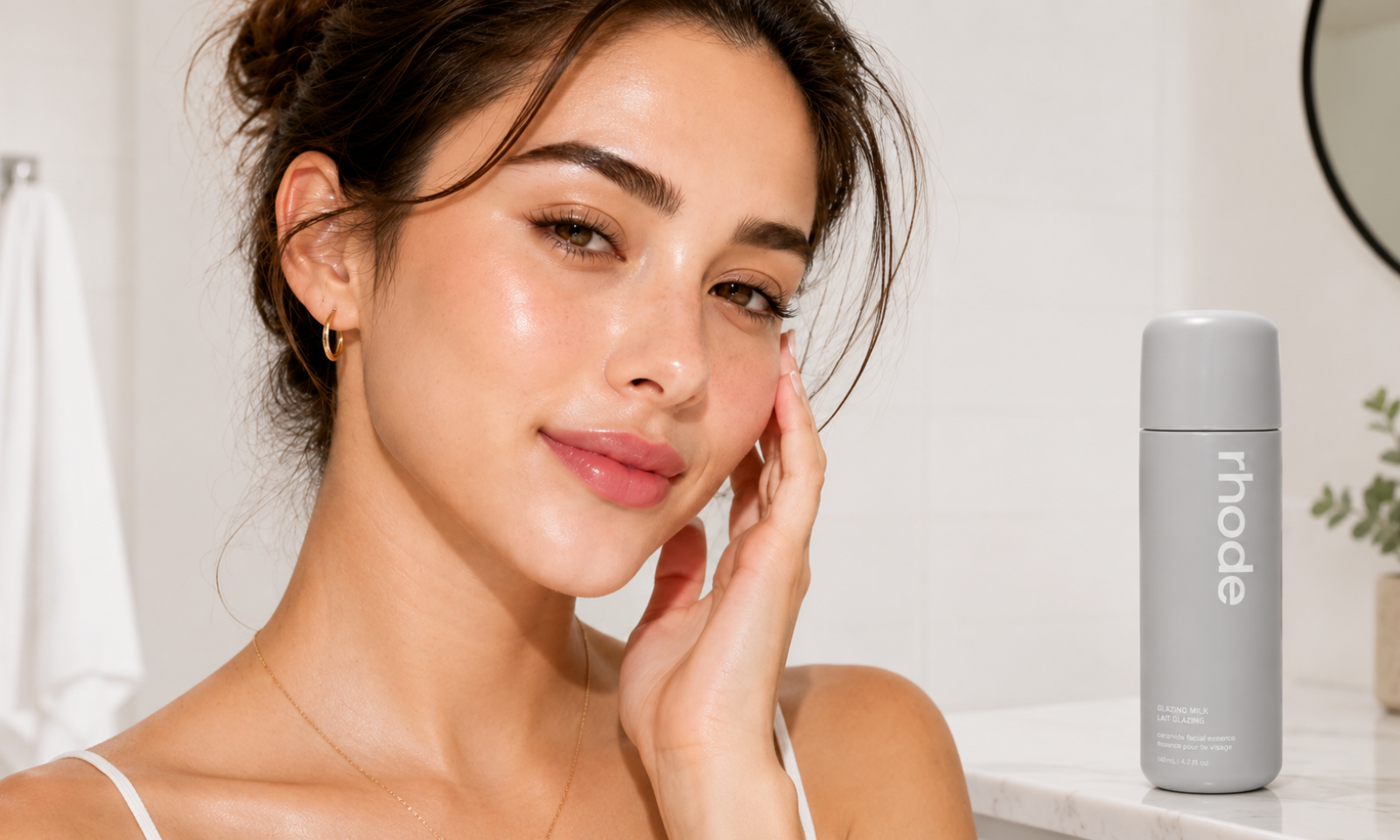
What Rhode Glazing Milk Actually Does
Rhode the brand launched in 2022, but the product everyone’s chasing — Glazing Milk — arrived in June 2023 at $32. It’s a milky essence-toner hybrid meant to be the first step after cleansing: hydrate, calm, and prep skin for everything that follows.
What’s inside is genuinely well-built, and it’s the bar any alternative has to clear:
- A ceramide trio — Ceramide NP, AP, and EOP — the lipids that rebuild the skin barrier
- Four forms of hyaluronic acid at different molecular weights for layered hydration
- A mineral complex of copper, magnesium, and zinc
- Supporting barrier lipids — cholesterol, phytosphingosine, and fatty acids — plus beta-glucan and vitamin E
The payoff is two things at once: real barrier support and that wet-looking “glaze.” It even carries a National Eczema Association seal. So a worthy alternative isn’t just any dewy toner — it needs that milky texture + ceramide-led barrier system.
The K-Beauty Milky Toners That Came First
Here are four Korean products that hit the same milky-glaze brief — judged on format, ingredients, and price.
Laneige Cream Skin Toner & Moisturizer — The Original (~$36)
This is the product that created the milky-toner category in 2018. It’s a two-in-one toner-moisturizer built on a Ceramide + Peptide complex, from Amorepacific — one of Korea’s oldest beauty houses. One honest note: at around $36 it’s not cheaper than Rhode. It’s not a dupe. It’s the blueprint Rhode’s category is built on.

Anua Rice 70 Glow Milky Toner — The Closest Match, For Less (~$21)
If you want one product that matches Glazing Milk on texture and actives and comes in under the price, this is it. It’s a true milky toner carrying the same ceramide trio (NP, AP, EOP) plus phytosphingosine and cholesterol as Rhode, layered with multi-weight hyaluronic acid — and it adds niacinamide for brightening that Rhode doesn’t have. For most people searching for an alternative, this is the answer.

Mixsoon Soybean Milk Serum — The Fermented Milk (~$38)
A literal “face milk” with a nano-sized Ceramide NP, plus cholesterol and phytosterols for the barrier, 72-hour fermented soy for glow, and peptides and vegan collagen for bounce. It leans more “nourish + brighten” than Rhode’s pure barrier focus, but the milky finish and that chok-chok glow are right on theme.

Aestura Atobarrier 365 Hydro Essence — The Dermocosmetic Pick (~$30)
Here’s the full-circle moment: Aestura is Amorepacific’s dermatologist-tier brand — the same parent company as Laneige. Its Hydro Essence is a barrier “boosting essence” applied right after cleansing, exactly like Glazing Milk’s role in the routine. It’s built on a real multi-ceramide barrier system (Ceramide NP, biomimetic ceramides, cholesterol, phytosphingosine, sphingolipids) and is formulated for the most reactive, eczema-prone skin. If your skin barrier is the actual concern under the glow, this is the clinical choice.

Rhode Glazing Milk vs. the K-Beauty Originals
| Product | Type | Ceramides | Standout extras | Approx. price |
|---|---|---|---|---|
| Rhode Glazing Milk | Milky essence | NP, AP, EOP | Cu/Mg/Zn mineral complex | $32 (140ml) |
| Laneige Cream Skin | Milky toner-moisturizer | NP | Peptide complex (the OG, 2018) | ~$36 |
| Anua Rice 70 Glow | Milky toner | NP, AP, EOP | Niacinamide brightening | ~$21 |
| Mixsoon Soybean Milk Serum | Milky serum | NP (nano) | Fermented soy, peptides, collagen | ~$38 |
| Aestura Atobarrier 365 Hydro Essence | Boosting essence | NP + biomimetic | Dermocosmetic barrier system | ~$30 |
Prices are approximate and vary by retailer/size
So, What’s the Best Rhode Glazing Milk Dupe?
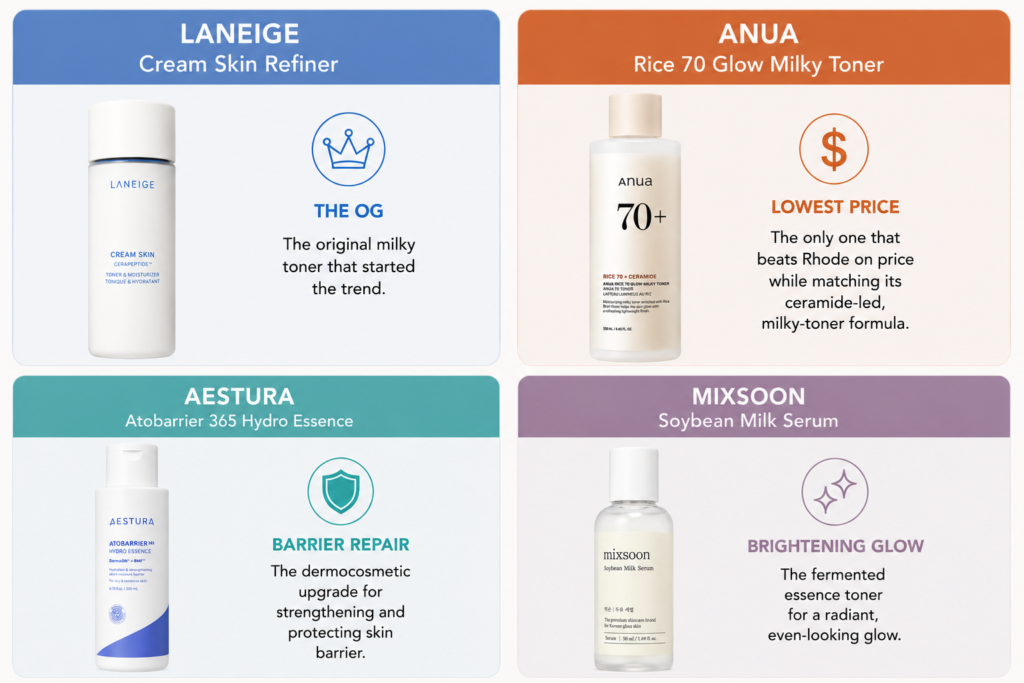
If “dupe” means same glow for less money, the honest answer is Anua Rice 70 Glow Milky Toner — it’s the only one of the four that beats Rhode on price while matching its ceramide-led, milky-toner formula. The others aren’t really dupes, and that’s the point: Laneige is the original the whole category copied, Aestura is the dermocosmetic upgrade, and Mixsoon is the fermented-glow take. Choose by goal — lowest price (Anua), barrier repair (Aestura), brightening glow (Mixsoon), or the OG (Laneige).
FAQ
Q. Is there a cheaper Rhode Glazing Milk dupe?
Yes. The closest cheaper match is Anua Rice 70 Glow Milky Toner (~$21) — a milky toner with the same ceramide trio (NP, AP, EOP) plus phytosphingosine and cholesterol, in roughly the same prep-step role, for about $11 less than Rhode.
Q. Is Rhode Glazing Milk just a copy of Korean milky toners?
Not a copy — but it’s clearly part of a category Korea created. Laneige defined the milky-toner format in 2018, and the “glass skin” goal Rhode markets as “glazed donut” is Korean in origin. Rhode’s formula is its own (the mineral complex is a nice touch), but the genre isn’t new.
Q. What’s the difference between glass skin and glazed donut skin?
They’re nearly the same goal. Glass skin (the Korean original) emphasizes poreless, translucent clarity; glazed donut skin (the Hailey Bieber rebrand) leans into a wetter, more overtly dewy shine. Both are achieved through hydration layering.
Q. Can these replace my moisturizer?
Some can. Laneige Cream Skin is built as a toner-moisturizer hybrid; the others are best as a hydrating prep step under a moisturizer, especially for dry skin.