
You’ve tried the salicylic acid. You’ve tried the benzoyl peroxide. Maybe you even finished a course of antibiotics from your doctor. And yet those tiny, uniform, itchy bumps across your forehead, chest, or back haven’t budged — or somehow got worse. If that sounds familiar, you may not be dealing with regular acne at all. You may be dealing with fungal acne, and the fix starts with building a fungal acne safe Korean skincare routine that starves the yeast instead of feeding it.
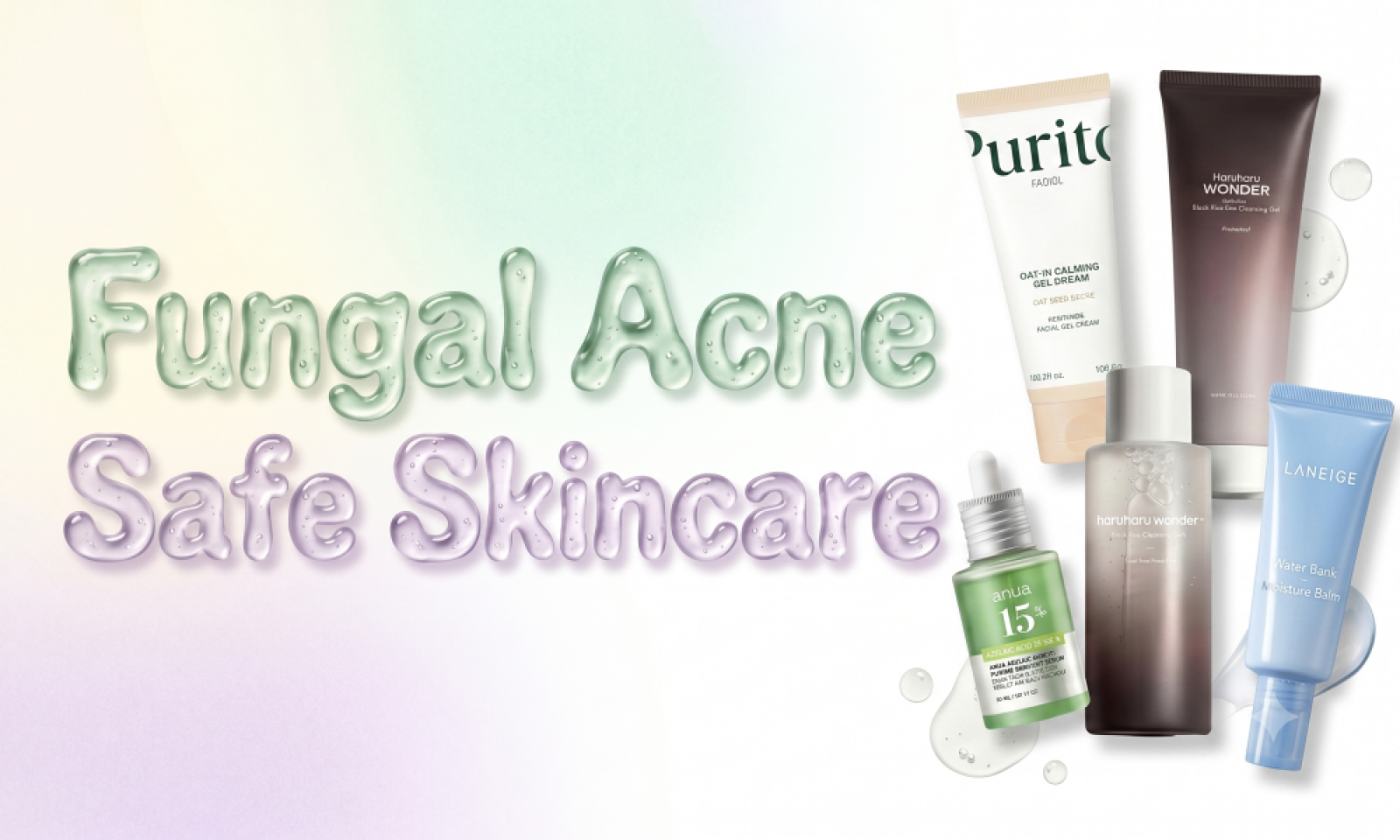
Below, we break down exactly what fungal acne is, which ingredients quietly feed it (including a few beloved K-beauty heroes), and a simple five-step routine built only from products that have been cross-checked as fungal acne safe.
What Is Fungal Acne? (Malassezia Folliculitis, Explained)
Fungal acne is the popular nickname for Malassezia folliculitis (also called Pityrosporum folliculitis). Despite the name, it isn’t acne at all. It’s an overgrowth of Malassezia — a yeast that naturally lives on everyone’s skin — inside the hair follicles. When that yeast multiplies unchecked, it inflames the follicle and produces the breakout you see.
A few signs help separate it from ordinary (bacterial) acne. Fungal acne bumps tend to be small and remarkably uniform in size, often appearing in clusters. They’re frequently itchy — true bacterial acne usually isn’t. And, frustratingly, standard acne treatments can make it worse rather than better, because they target bacteria, not yeast.
One important caveat up front: this guide is educational, not a diagnosis. Several conditions — including contact dermatitis and rosacea — can mimic fungal acne, so a board-certified dermatologist is the only one who can confirm it (sometimes with a quick in-office test). If your skin isn’t improving, please see one. Everything below assumes you’re building a gentle, yeast-aware routine alongside professional guidance.
What Causes Fungal Acne? The Ingredients That Feed Malassezia
Here’s the key piece of biology that makes a fungal acne safe Korean skincare routine possible: Malassezia can’t make its own fatty acids. It has to pull them from its surroundings — including the oils and esters in your skincare. Lab research shows the yeast feeds on fatty acids in a carbon-chain range of roughly C11 to C24. Remove that food source, and you starve the overgrowth. That’s the entire strategy.
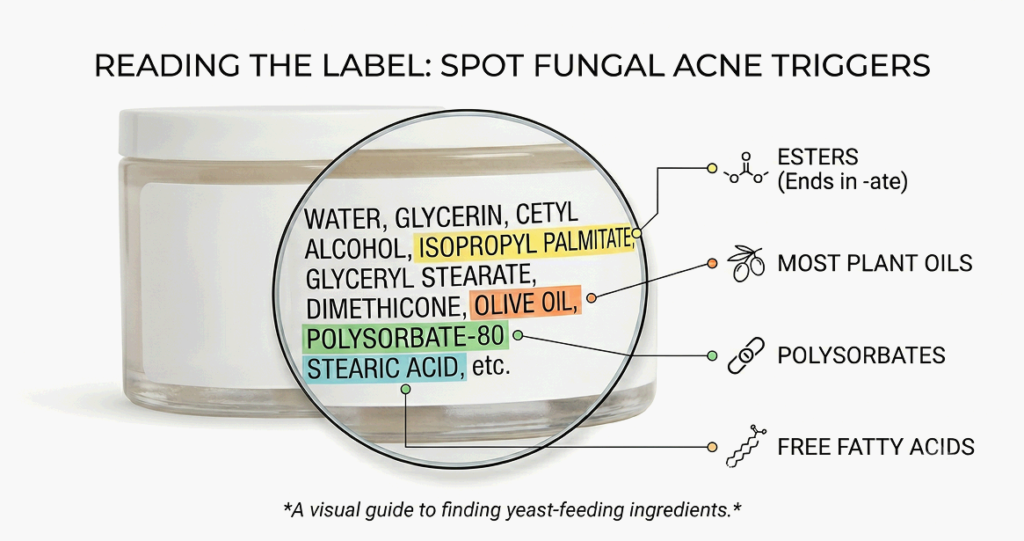
In practice, that means learning to spot a handful of trigger categories on an ingredient list:
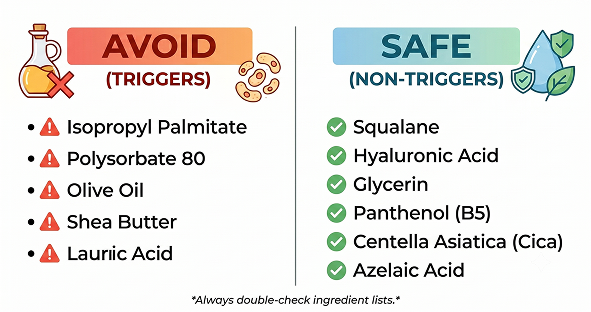
- Most plant oils — coconut, olive, argan, sweet almond, and more. (A few exceptions are safe: squalane, MCT oil / caprylic-capric triglyceride, and mineral oil.)
- Free fatty acids — lauric, myristic, palmitic, stearic, and oleic acid.
- Many esters — often ending in “-ate” (isopropyl palmitate, glyceryl stearate, and similar).
- Polysorbates — especially polysorbate-20 and -80, which can shuttle lipids into follicles.
- Some fermented ingredients — more on this next, because it’s where K-beauty needs a closer look.
The K-Beauty Catch: When “Fermented” Hero Ingredients Backfire
Korean beauty built much of its reputation on fermented ingredients — galactomyces, saccharomyces, and other ferment filtrates prized for glow and anti-aging. They’re genuinely brilliant for a lot of skin. But for fungal acne, they can be a problem: fermentation breaks compounds down into the amino acids and lipids that Malassezia can metabolize directly. In other words, the very thing that makes a fermented essence feel luxurious can also feed the yeast.
This is exactly why “K-beauty is good for fungal acne” is too sloppy to be true. The honest version is more useful: K-beauty offers some of the best fungal acne safe products on the market — if you choose carefully. That’s why every pick in this guide was verified on its full ingredient data, not on brand reputation. And one practical rule travels well: trust the full INCI list, not the marketing copy. (We caught a “cleansing oil” claim on one of our own picks that turned out, on inspection, to contain no oil at all — just gentle coconut-derived surfactants that rinse off.)
How Strict Do You Really Need to Be?
A fair question, because the internet can make this feel terrifying. The “avoid every fatty acid from C11–C24” rule comes largely from in-vitro studies — yeast grown in a petri dish, not skin. Real skin is a living system with a microbiome, immune defenses, and a barrier, and some lipids behave very differently once they’re bound inside a finished formula (an emulsifier that contains a fatty acid is not the same as applying that free fatty acid).
The practical takeaway: don’t chase a perfectly “pure” routine out of fear. Aim for products that avoid the obvious leave-on triggers — straight oils, free fatty acids, high-concentration fermented essences — and don’t panic over a trace ingredient near the bottom of an INCI list, especially in a rinse-off product. Above all, patch test anything new for a few days before committing. Your skin’s reaction is better data than any list
Fungal Acne Safe Ingredients to Look For
Starving the yeast is only half the job; you still need to cleanse, hydrate, treat, and protect. The good news is there’s a long list of ingredients Malassezia can’t use. For hydration and barrier support, look for squalane, hyaluronic acid, panthenol, beta-glucan, glycerin, urea, centella asiatica (cica), and oat. For active treatment, the strongest options are azelaic acid (antifungal, antibacterial, and anti-inflammatory), niacinamide (barrier support and oil control), salicylic acid (keeps follicles clear), sulfur, and zinc.
A quick, honest note on azelaic acid since it anchors the routine below: it’s well-established for redness, rosacea, and blemishes, and it reduces the free fatty acids Malassezia relies on, so it’s a smart fit for yeast-prone skin. It is not, however, formally classified as a dedicated antifungal drug — think of it as strong, multi-tasking support rather than a cure.
The Best Fungal Acne Safe K-Beauty Routine: 5 Verified Picks
| Step | Product | Size | US Price (approx.) |
|---|---|---|---|
| 1. Cleanser | Haruharu Wonder Black Rice Moisture 5.5 Soft Cleansing Gel | 100 ml | $12–17 |
| 2. Toner | Haruharu Wonder Black Rice Hyaluronic Toner (Sensitive Skin) | 150 ml | $18.50–22 |
| 3. Treatment serum | Anua Azelaic Acid 15+ Intense Calming Serum | 30 ml | $22–24 |
| 4. Moisturizer | PURITO Oat-In Calming Gel Cream | 100 ml | ~$19 |
| 5. Sunscreen | Laneige Water Bank UV Barrier Sunscreen SPF 50+ PA++++ | 50 ml | $38–42 |
Step 1 — Cleanser: Haruharu Wonder Black Rice Moisture 5.5 Soft Cleansing Gel

A soap-free, low-pH (5.5) gel cleanser that’s the most popular fungal acne safe pick in Haruharu’s lineup — and an easy one to love. Gentle coconut-derived surfactants lift away dirt, sweat, and excess oil without stripping, while fermented black rice, bamboo shoot, ginseng, beta-glucan, and trehalose hydrate and support the barrier as you cleanse. Crucially, the full ingredient list contains no oils and no free fatty acids, it’s fragrance- and alcohol-free, and it rinses clean. Because it isn’t an exfoliating acid cleanser, it’s gentle enough to use morning and night, every day.
Step 2 — Toner: Haruharu Wonder Black Rice Hyaluronic Toner (Sensitive Skin)

After cleansing, this fragrance-free, alcohol-free toner restores hydration without reintroducing triggers. It leans on hyaluronic acid and beta-glucan — both reliably fungal acne safe humectants — for a plump, calmed finish that preps skin for treatment. The “Sensitive Skin” version drops the essential oils found in some toners, which is exactly what reactive, yeast-prone skin wants.
Step 3 — Treatment Serum: Anua Azelaic Acid 15+ Intense Calming Serum

This is the workhorse of the routine. A serum delivering 15% azelaic acid to calm redness, fade post-blemish marks, and reduce the free fatty acids yeast feeds on — rounded out with salicylic acid (BHA), centella, ceramide, and zinc, so it both treats and supports the barrier. At 15% it sits on the stronger side, so introduce it slowly: once or twice a week at first, building toward daily as tolerated, and always pair daytime use with sunscreen. If your skin is very reactive or brand-new to azelaic acid, Anua’s gentler 10% version is a softer entry point.
Step 4 — Moisturizer: PURITO Oat-In Calming Gel Cream

A featherweight gel-cream built on 77% oat seed water, with panthenol, beta-glucan, and squalane (one of the safe lipids) doing the hydrating and barrier-supporting work. The ingredient list is short, fragrance-free, and free of the oils and esters that trigger flare-ups, which is why it’s a long-standing favorite for fungal-acne-prone skin. The gel texture absorbs fast and layers cleanly under sunscreen — ideal for oily or combination skin, and comfortable enough for everyone else.
Step 5 — Sunscreen: Laneige Water Bank UV Barrier Sunscreen SPF 50+ PA++++
![WATER BANK UV Barrier Sunscreen [SPF50+/PA++++]](https://img.hwahae.co.kr/products/2134631/2134631_20250310141725.jpg)
Sunscreen is the hardest fungal-acne-safe category to get right — many formulas are rich, occlusive, or full of triggering esters — so a clean, comfortable option is worth its weight. This SPF 50+ PA++++ formula has a serum-like, non-sticky finish with no white cast, is non-comedogenic tested, and leans on hyaluronic acid for barrier support.
Your Daily Fungal Acne Safe Routine (AM / PM)
Putting the five picks together, here’s how a simple day looks. Ease in one product at a time so you can spot what your skin likes.
| AM | PM | |
|---|---|---|
| 1 | Cleanser | Cleanser |
| 2 | Toner | Toner |
| 3 | Azelaic serum (optional in AM) | Azelaic serum |
| 4 | Moisturizer | Moisturizer |
| 5 | Sunscreen (non-negotiable) | — |
Frequency matters as much as order: build the azelaic serum up gradually rather than going all-in on day one. Give any new routine four to six weeks before judging results — yeast-related breakouts settle slowly, and consistency beats intensity.
FAQ
Q. Is Korean skincare bad for fungal acne?
No — but not all of it is safe, either. The fermented essences K-beauty is famous for (galactomyces, saccharomyces) can feed Malassezia, while plenty of other K-beauty products are excellent, genuinely fungal acne safe choices. The trick is reading the full ingredient list rather than trusting the category.
Q. Can I use fermented essences if I have fungal acne?
It’s best to avoid high-concentration, leave-on fermented essences while you’re actively breaking out, since the broken-down compounds can feed the yeast. A trace ferment near the end of an INCI list — especially in a rinse-off product — is far lower risk. Patch test, and watch how your skin responds.
Q. How long until fungal acne clears?
Expect weeks, not days. Most people give a yeast-aware routine four to six weeks of consistent use before judging it. If there’s no improvement — or it’s spreading — that’s your cue to see a dermatologist, who may prescribe a dedicated antifungal.
Q. Do I still need to see a dermatologist?
If you’re unsure of the diagnosis or things aren’t improving, yes. Fungal acne mimics other conditions, and only a professional can confirm it and prescribe stronger antifungal treatment when a routine alone isn’t enough. This guide is a starting point, not a substitute for care.
Fungal acne doesn’t respond to willpower or to more acne products — it responds to a routine that stops feeding the yeast. The five picks above aren’t labeled “miracle dupes”; they’re simply verified, fungal acne safe Korean skincare that covers every step without the oils, esters, and fermented triggers that keep Malassezia thriving. Start gently, stay consistent, protect with SPF, and loop in a dermatologist if your skin isn’t turning the corner.